

Monica on Fox Bulls and Bears with Liz Claman and David Asman discussing stock market volatility.
Monica on Fox Bulls and Bears with Liz Claman and David Asman discussing stock market volatility.
Posted in Fox Business, Video
Tagged FBN Bulls & Bears, Fox Bulls and Bears, Fox Business, Monica Mehta, seventh capital

Monica joins Cavuto’s All Star Business Panel on Weds 2/16 at 6p EST.
Posted in Fox Business, Video
Tagged cavuto, fox business network, Monica Mehta, seventh capital
Posted in Fox Business, Uncategorized, Video
Tagged Bulls & Bears, FBN, Fox Business, Fox Business Bulls & Bears, Monica Mehta, seventh capital

Converts look like equity, but taste like debt. To serial investors they’re brussel sprouts. But to certain entrepreneurs and angels, they’re what’s for dinner.
By Monica Mehta
Monica Mehta returns to the Bulls and Bears expert panel to discuss US and China relations and impact to the broader economy.
Posted in Fox Business, Video
Tagged David Asman, Fox Business Bulls & Bears, Liz Claman, Monica Mehta, seventh capital

Monica Mehta returns to Fox Business Network’s Bulls & Bears to discuss European sovereign debt and talk cupcakes. That’s right, PIIGS and carbs all in the same hour! Pictured here as she chats with hosts Liz Claman and David Asman about the initial public offering of Crumbs.
Posted in Fox Business, Video
Tagged Crumbs IPO, FBN Bulls & Bears, Fox Business, Monica Mehta

In recent years, University of Pennsylvania psychologists that specialize in the study of success have pinpointed the traits most closely linked with exceptional achievement. More so than talent, IQ or even self control, they determined it’s persistent passion or the ability to stay on track for a very long period of time when the going gets tough.
In their study of underprivileged kids that beat to odds (to graduate from HS and go onto college), 300 geniuses that realize their potential, West Point cadets that survive grueling training, it’s the same trait or what they describe as Grit that leads to exceptional success. Grit is a theme that popped up over and over in my interviews with self made entrepreneurs as I conducted research for The Entrepreneurial Instinct.
I was fascinated to see the same themes pop up in a new short film about Arnold Schwarzenegger’s early years. Before he was a body building champ, actor and politician, he was a teenager in Austria with a vision that no one could quite understand. Listen to his conversation with Grantland’s Bill Simmons:
Posted in EI Blog
Tagged Arnold Schwarzenegger, Bill Simmons, grit, Monica Mehta, the entrepreneurial instinct, visualization

The ancient practice of yoga is said to cure depression, reduce anxiety, and increase overall happiness. This post will explore how yoga changes the brain and how you can benefit most from it- even if an hour-long yoga class isn’t in the works. As noted in a Sept 2011 post in Psychology Today:
First, the things you do (your actions) and the thoughts you have physically change the firing patterns and chemical composition of your brain. Second, actions as simple as changing your posture, relaxing the muscles of your face, or slowing your breathing rate, can have a profound positive impact on how your brain deals with stress.
Neuroscientist Alex Korb, Ph.D. was convinced to attend a first yoga class with his father a long time practitioner. He made some interesting observations about the practice and the brain. According to him yoga is about breathing and attention. It is not about how flexible you are. Many of the poses require you to exert all your energy in order to hold that pose. Yoga teachers tell you to breathe through the pain and smile. The positive effects of yoga occur not because the practice is relaxing but because the practice is stressful. It is your attempt to remain calm during that stress that gives rise to yoga’s greatest neurobiological benefit.
You don’t have to commit to a whole practice to gain the positive benefits. By breathing deeply and slowly, relaxing your facial muscles, clearing your head of anxious thoughts, and focusing on the present you can begin to implement the benefits of yoga into your life.
Dr. Korb suggests that over time you will start to retrain your automatic stress reaction and replace it with one more conducive to happiness and overall well-being.
Remember without the sustained intentions of focus on the present and calming the mind going to yoga class is literally just going through the motions. By identifying stresses in your own life and taking a minute to breathe deeply and smile you can reap the neurobiological benefits that yoga offers starting now.
Posted in EI Blog
Tagged Monica Mehta, productivity, psychology today, yoga and brain

Dopamine plays a critical role in regulating your mood, emotions, ability to make smart decisions, and sleep. An easy way to stimulate your brain to produce more of this wonder chemical is to eat the right snacks. Understanding the effects of food on our mood and ability to make smart decisions is the first step to seeing results.
Saturated fats, for example, reduce dopamine levels as well as clog arteries. Stay clear of McDonalds and Oreos. This will have a profound effect on your mood. While coffee is necessary to get the cognitive juices flowing be aware that caffeine boosts the production of serotonin while lowering dopamine levels. Aim for one cup a day.
Make sure to eat fruits and vegetables rich in antioxidants. Free radicals lower dopamine levels in the body and foods rich in antioxidants will keep these levels high. Incorporate these 10 foods into your day to boost dopamine levels naturally and quickly.
1. Bananas
2. Red Beans
3. Blueberries
4. Cranberries
5. Artichokes
6. Prunes
7. Strawberries
8. Raw almonds
9. Sunflower seeds
10. Sesame Seeds
Posted in EI Blog
Tagged brain science and productivity, dopamine production, Monica Mehta, super foods

The ability to take smart risks is the single defining attribute of a successful entrepreneur, but at times the primal brain’s aversion to fear can make risk-taking a difficult task.
On personality tests, entrepreneurs scored higher ratings on questions that tested for impulsive behavior. Additionally, cognitive flexibility, or the ability to switch a plan of action depending on the situation’s context, played a key role in making smart business decisions. Combined with an impulsive personality, this cognitive flexibility gives risk-takers a particular edge over people who don’t have an impulsive nature.
Our brain doesn’t like risk, especially when it involves loss. Risk can also make us anxious and inhibit our ability to think creatively and problem solve efficiently.
Fear is the strongest variable that stands in the way of success, as it inhibits your brain from taking rewarding risks. This notion of loss aversion describes why people often unconsciously choose avoiding losses over acquiring gains.
In a 2009 Scientific American Mind article on amygdala damage, Dr. De Martino explains, “Loss aversion reflects a very ancient mechanism in the brain. Think about an animal. It has to get food, but at the same time it has to protect itself from predators. It would be very wise for an animal to weigh gains and losses from an evolutionary perspective. “
It’s fairly obvious that financial well-being is necessary for survival in the modern world. Almost all entrepreneurs are forced to put their financial security into jeopardy at some point. Their trick is they don’t fear loss the way everyone else does. It’s important to remember that the anxiety and general unpleasantness associated with the thought of loss occurs in the brain, and it can’t physically harm you.
The ability to take successful risks occurs in the brain and its biggest deterrent, fear, also exists in the brain. By understanding how your primal brain makes decisions in the modern world, you can learn some simple tricks to help train your brain, silence the fear associated with loss, and make better decisions now.
Can you think of a time when your ability to take risks was rewarding? Why do you think you were able to move past the fear accompanied with taking risks? Tell us about a time took a rewarding risk and how it worked out. Share your story in the comment section below.
Posted in EI Blog
Tagged entrepreneurial instinct, entrepreneurial risk, Monica Mehta, risk taking and brain
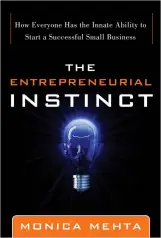
The Entrepreneurial Instinct (McGraw-Hill, Sept 14 2012)


Monica Mehta is an investor, author and finance expert. She is a frequent contributor for CNN, Fox News, BloombergTV, MSNBC, INC Magazine and Bloomberg BusinessWeek. She is the author of The Entrepreneurial Instinct (McGraw-Hill, Sept 2012)



 Monica Mehta